How to Play Data Center Fan
Data Center Fan is a free isometric tycoon game about building and running a data center — from a single dusty desktop in your garage to a global hyperscale complex. This guide covers everything a new player needs: the core loop, resource management, contracts, events, and how to grow fast without going broke.
Read the room before you spend.
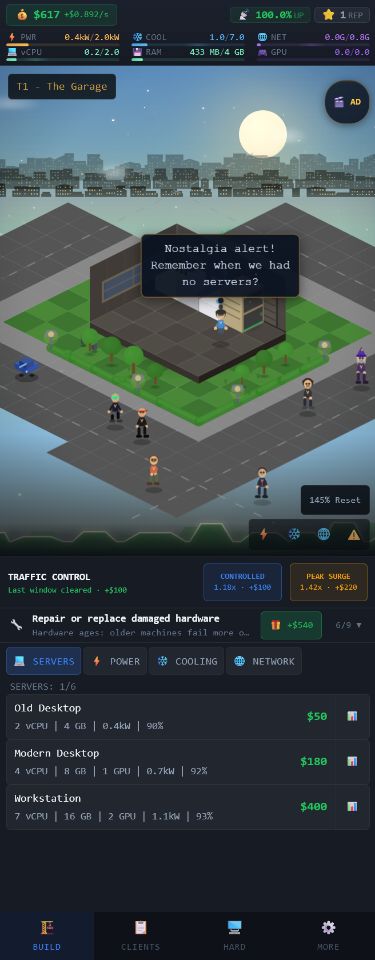
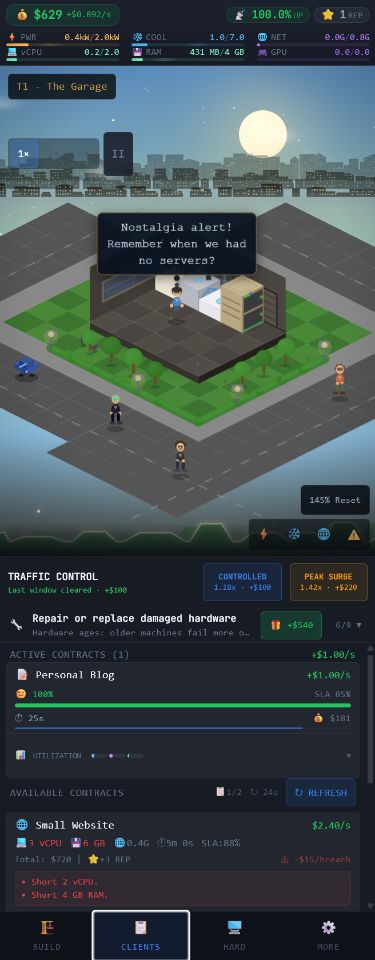
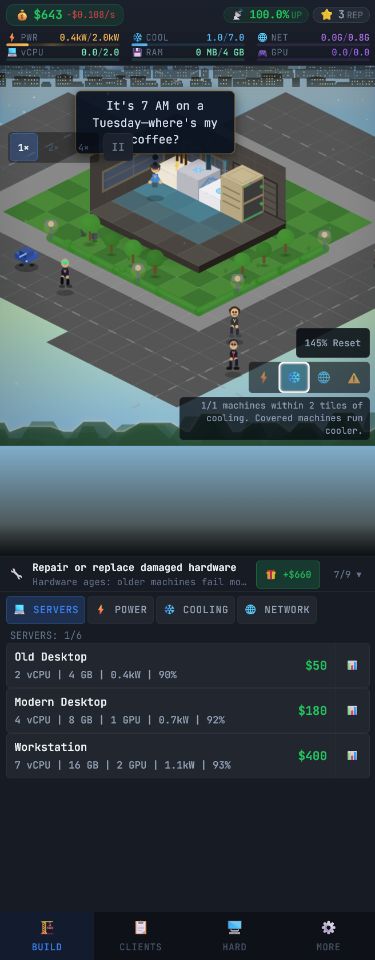
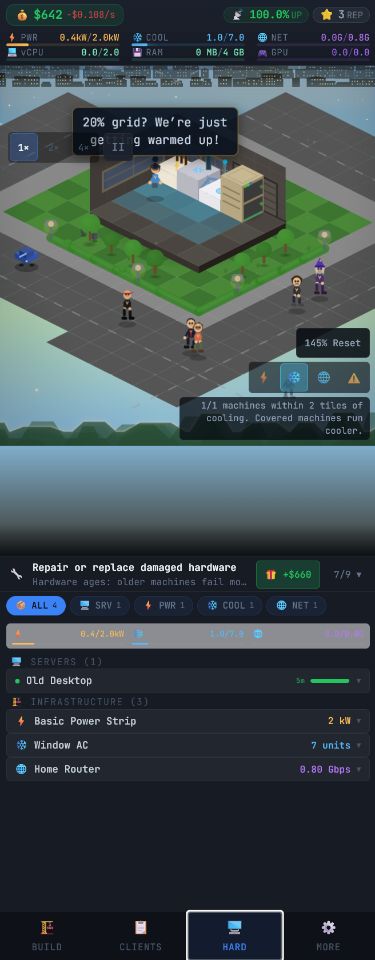
Current in-game screens, not marketing mockups: the operating HUD, contract board and cooling overlay.
The core loop
Every run follows the same rhythm: build capacity, sign work that fits, protect the SLA, resolve the next operational problem and reinvest the result. Every machine occupies a floor tile, draws power, creates heat and contributes a specific mix of vCPU, RAM or GPU capacity.
The objective is reliable compounding rather than buying every unlocked item. The best purchase fixes the next bottleneck while leaving enough cash to survive a failure.
Your first shift
- Read the rail — Check power, cooling, network, vCPU, RAM and GPU as used versus available. The rail is the authority, not how full the room looks.
- Check the utility backbone — Confirm power, cooling and network headroom before adding another load-producing machine.
- Buy for the blocker — Use the forecast button and choose the smallest server that unlocks useful work without emptying the repair reserve.
- Accept one safe contract — Open Clients and choose work the room can over-serve. The card lists every shortage before acceptance.
- Hold the SLA — Keep every resource healthy until the contract completes. Satisfaction recovers only while all requirements are met.
- Claim and reinvest — Collect objective rewards and use the surplus on the next constraint, not the most impressive unlocked item.

Read the six resource signals
Power, cooling and network form the utility backbone. vCPU, RAM and GPU are the workload capacity supplied by servers. A contract can fit on five rails and still fail because the sixth is short.
Do not plan to sit at 100% utilization across several signals. A traffic spike, damaged machine or event multiplier can turn a mathematically valid contract into an SLA breach. Valuable clients deserve visible headroom.
Contracts, SLAs and traffic windows
- Check fit, remaining margin, SLA, duration, penalty and workload traits before accepting.
- Blocked offers explain the exact missing vCPU, RAM, GPU, bandwidth, reputation or client slot.
- Controlled traffic windows offer moderate temporary load; peak surges pay more but consume more headroom.
- Throttle a live window when protecting the facility is worth more than the maximum reward.
- A payout is not profit if it produces breaches, repairs and reputation loss.
Events, incidents and recovery
Events demand an immediate choice and can exchange cash, temporary multipliers or forced downtime. Incident chains develop through warning, preparation, active incident, response and postmortem. Read the stated cause: fixing it during the warning can avert the incident completely.
When uptime falls, return to 1×, identify the full resource rail, check active effects, inspect hardware health and restore the bottleneck before accepting more work. The postmortem prevention line is the runbook for the next occurrence.
Staff, research and prestige
As you grow, hire technicians, network engineers, security analysts, sales reps, facilities managers and a CTO. Staff level up over time and each improves a different part of the operation.
Unlock research to boost income, efficiency and reliability. When you reach the top tiers, trigger an IPO to prestige: you reset the run but earn Innovation Points that buy permanent upgrades, making every future run stronger.
Operator doctrine
- Read the rail before every commitment.
- Capacity without headroom is already an incident.
- Keep repair cash instead of spending the account to zero.
- Fix causes during warnings, not consequences after failures.
- The next bottleneck — not the largest server — determines the right purchase.
Quick links
Frequently asked questions
How do I unlock the next tier?
Each tier unlocks when you reach both a cash threshold and a reputation threshold. Keep contracts served to grow reputation while banking cash toward the requirement.
Why are my servers failing?
Servers overheat when cooling cannot keep up with the heat they produce, and hardware degrades with use. Add cooling capacity and repair or replace worn hardware to keep uptime high.
What is an IPO in Data Center Fan?
An IPO is the prestige mechanic. At the top tiers you can reset your run in exchange for Innovation Points, which buy permanent upgrades such as more starting cash, higher income and cheaper power.