Liquid Cooling and AI Rack Density
Follow the heat out of a dense cabinet and see where air runs out, what liquid replaces and what it does not.
Learning outcomes
- Explain why air has a practical density ceiling
- Compare rear-door, direct-to-chip and immersion heat paths
- Account for the residual air load a liquid deployment leaves
HEAT CAPTURE FRACTION
CAPTURE = HEAT REMOVED BY LIQUID ÷ TOTAL CABINET HEAT
The remainder still enters the room as air. A design that does not state this fraction has not planned for the part it does not capture.
Air does not fail; it runs out of room
Air carries heat in proportion to how much of it moves and how much its temperature rises. As a cabinet draws more power, one of those two has to increase. Raising the temperature rise is limited by what equipment will tolerate at its inlet, so the volume of air has to grow — and delivering, containing and returning that volume through a data hall becomes progressively harder.
The limit is practical rather than a hard number. It arrives as floor tiles that cannot pass enough air, as containment that cannot be sealed well enough, as fan energy that grows faster than the load, and as cabinets whose own fans are working hard enough to become a meaningful part of the power draw. A room does not stop working at a threshold; it becomes steadily less reasonable.
Three ways to put liquid closer to the heat
A rear-door heat exchanger leaves the cabinet air-cooled and captures the exhaust before it reaches the room. It is the least disruptive step: airflow direction and equipment are unchanged, and it can be applied cabinet by cabinet. Passive versions rely on equipment fans to overcome the coil; active versions add their own fans, and therefore their own power and failure considerations.
Direct-to-chip puts cold plates against the processors and accelerators, so most of the heat leaves in fluid rather than air. Immersion goes further and submerges the equipment in a dielectric fluid, removing the air path almost entirely. Each step shortens the thermal path and each step changes serviceability, weight, equipment qualification and what the facility has to provide.
The residual load is the part that surprises people
Memory, drives, power conversion and network components are generally not liquid-cooled, so a meaningful fraction of a cabinet’s heat still enters the air even in a direct-to-chip deployment. Designs that state a capture fraction and size the air side for the remainder behave as expected. Designs that assume liquid handles everything discover a hot room with an air system that was scaled down for a load that did not disappear.
The same logic applies to the room around a liquid pod. Reducing the air load in one zone changes the air balance of the hall, and a cooling system sized for the old distribution may not deliver sensibly to the new one. Mixed estates need the air design revisited, not simply reduced.
A liquid loop is a new dependency, not a removed one
Cabinet-level liquid is usually separated from the facility loop by a coolant distribution unit, which controls the supply temperature and flow the equipment sees. That unit has power, controls and a failure behaviour, and everything downstream of it shares them — which makes it exactly the kind of shared dependency the power chain lesson teaches operators to look for.
Around it sits work that an air-cooled estate has never had to do: connection types and whether they can be made and broken safely, leak detection and what it triggers, fluid chemistry and filtration, and a service procedure for a node with fluid attached. None of this is exotic, and all of it is new.
Density changes the building, not only the cabinet
A dense deployment raises questions well outside the thermal design. Floor loading, because a filled immersion tank or a liquid-cooled cabinet can be a substantial structural load. Electrical distribution, because the same footprint now needs several times the power. Commissioning, because the acceptance tests for a liquid system are not the ones an air-cooled hall used.
This is why high density is a facility decision rather than a rack upgrade. The useful sequence is to establish the heat path first, then the power path, then the structural and service consequences, then the equipment — rather than starting from a product and discovering the building afterwards.
How it appears in Data Center Fan
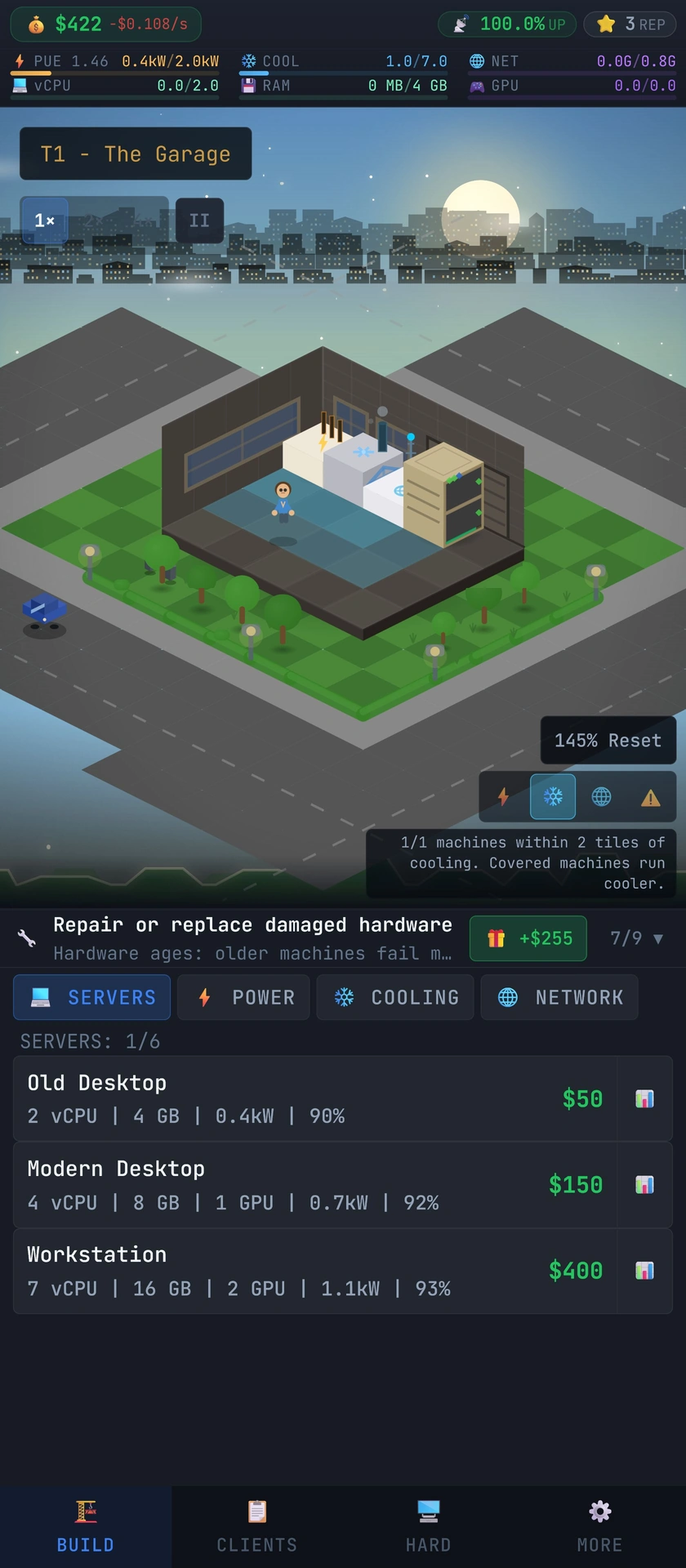
Data Center Fan represents advanced cooling as efficiency and capacity effects on the facility. The game does not model fluid loops, capture fractions or coolant distribution; the Academy lab and the Design Pro liquid pod treat those separately and label their boundaries.
Common misconception
“Liquid cooling removes the need for air cooling.” Components that are not liquid-cooled still reject heat into the room. The residual air load has to be planned for explicitly, and a deployment that assumes otherwise produces a hot hall.
Knowledge check
A direct-to-chip deployment captures 75 percent of cabinet heat into liquid. What happens to the rest?
- It is eliminated
- It still enters the room as air
- It is absorbed by the coolant distribution unit
Components not on cold plates reject heat into the air as before. The air system still has to handle that fraction, which is why designs state a capture fraction rather than assuming full capture.
Frequently asked questions
At what density does air cooling stop working?
There is no single threshold. Air becomes progressively less reasonable as the volume needed grows — showing up as tiles that cannot deliver enough air, containment that cannot be sealed well enough and fan energy that rises faster than the load. Where a given room stops being sensible depends on its air distribution, containment and supply temperature.
What is the difference between direct-to-chip and immersion cooling?
Direct-to-chip puts cold plates against major components and leaves the rest of the cabinet air-cooled. Immersion submerges the equipment in a dielectric fluid, removing the air path almost entirely. Immersion moves more heat but changes serviceability, weight, fluid handling and equipment qualification far more.
Do AI servers need liquid cooling?
Not universally, but accelerator-dense configurations frequently exceed what a cabinet can reasonably be given in air. Whether a specific deployment needs it depends on the power per cabinet, the room’s air distribution and containment, and what the equipment manufacturer supports.
What is a CDU in liquid cooling?
A coolant distribution unit, which separates the cabinet-level fluid loop from the facility loop and controls the supply temperature and flow that equipment sees. It is a shared dependency for everything downstream of it and has its own power, controls and failure behaviour.
Is liquid cooling more efficient?
It can be, because a shorter thermal path allows warmer coolant temperatures and less fan energy, which can widen the window where mechanical cooling is reduced. The gain depends on the capture fraction, the loop temperatures and what happens to the residual air load — it is not automatic.
What happens if a liquid cooling loop leaks?
It depends on the fluid, the location and what detection is in place, which is why leak detection and a defined response are part of the design rather than an afterthought. The operational questions — who is notified, what is isolated, how a node is serviced — need answers before the first cabinet is installed.